
Stages of Dementia
Stages of Dementia
Understanding what may happen can help families prepare for what comes next.
Dementia is generally a progressive condition, meaning that changes in memory, thinking and everyday abilities tend to increase over time.
For simplicity, dementia is often described in three broad stages:
🌱 EARLY → 🌤️ MIDDLE → ❤️ LATE
These stages are not a calendar. There isn’t a specific amount of time that everyone spends in each one.
Think of them instead as a general guide to help families understand changing needs and plan appropriate support.
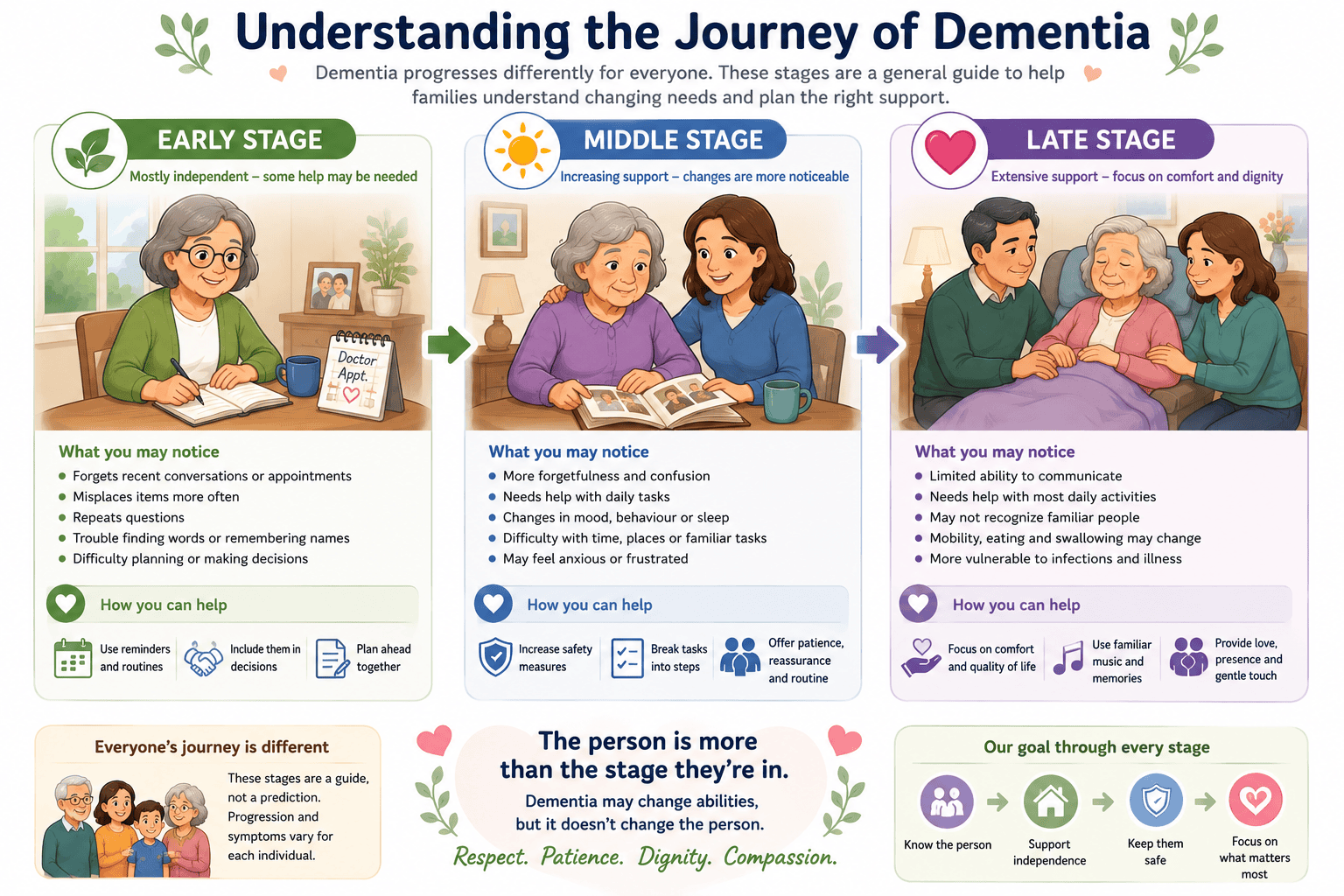

Early Stage
Mostly Independent — Some Help May Be Needed
In the early stage, changes may be subtle.
The person can often continue living quite independently. They may still drive, work, socialize, prepare meals and participate in their normal activities, depending on their individual abilities.
However, family and friends may begin noticing changes.
Memory & Thinking
A person may:
- Forget recent conversations or appointments
- Repeat questions
- Misplace belongings more frequently
- Have trouble remembering names or finding the right word
- Become confused about dates or times
- Have difficulty learning something new
- Take longer to make decisions
- Have more difficulty planning or organizing
Sometimes the person recognizes these changes themselves and becomes frustrated or worried.
Everyday example
Someone might walk into a room and forget why they went there, forget an appointment they normally would have remembered, or begin having difficulty keeping track of bills.
One isolated memory lapse doesn’t necessarily mean dementia. It’s the pattern and progression of changes that are important.
Daily Life During the Early Stage
This is a very important period for maintaining independence.
Instead of immediately taking over, families can introduce tools that make everyday life easier:
Calendars • Reminder notes • Medication organizers • Automatic bill payments • Large clocks • Phone reminders • Labels • Regular routines
The idea is:
Support rather than replace.
If someone can still make breakfast safely, let them make breakfast.
If they can still choose their clothes, let them choose.
If they can participate in decisions about their future, include them.
Communication in the Early Stage
Speak directly to the person rather than automatically speaking to their spouse or caregiver.
Give them time to find words and finish their thoughts.
Avoid constantly correcting small mistakes.
Most importantly, don’t assume that a diagnosis means the person can no longer make decisions.
Dementia does not erase someone’s voice.
This Is Also a Time to Plan
While the person can still participate fully in decisions, families should consider conversations about the future.
That can include:
Finances • Legal documents • Power of attorney • Healthcare wishes • Driving • Housing • Future care preferences • Emergency contacts
These aren’t always comfortable conversations, but making decisions together early can prevent much more difficult decisions later.

Middle Stage
Increasing Support Changes Become More Noticeable
The middle stage is often when dementia begins having a much greater impact on everyday life.
Memory and thinking difficulties usually become more noticeable, and the person may need increasing assistance.
This stage can also last a considerable amount of time.
Memory & Thinking
A person may:
- Forget important personal information
- Have greater difficulty recognizing people
- Become confused about where they are
- Lose track of the day or time
- Repeat questions or activities
- Have increasing difficulty following conversations
- Struggle with multi-step tasks
- Have difficulty making decisions
- Become confused in unfamiliar environments
They may remember something from 40 years ago surprisingly well while having difficulty remembering what happened this morning.
Everyday Activities May Become Harder
Someone may begin needing help with:
Choosing clothing, Getting dressed, Preparing meals
Taking medications, Shopping, Managing money, Using appliances
Bathing and Keeping appointments
Again, the goal should be to provide only as much help as is necessary.
If someone can put on their own shirt but needs help choosing it, place two appropriate shirts in front of them and let them choose.
Small choices preserve independence.
Changes in Mood & Behaviour
Some people may experience changes in mood, personality or behaviour. These can include:
Anxiety • Agitation • Suspicion • Restlessness • Apathy • Irritability • Sleep changes • Repetitive behaviour
A person may also become upset because they are confused or cannot communicate what they need.
Before assuming someone is simply “behaving badly,” ask:
What might this person be trying to communicate?
Are they hungry? Are they tired? Are they in pain? Is the room too noisy? Do they need the bathroom? Are they frightened? Are they looking for something familiar?
Sometimes behaviour is communication without words.
Safety Becomes Increasingly Important
During the middle stage, families may need to pay more attention to:
Getting lost or wandering • Falls • Cooking safety • Medication mistakes • Driving • Doors and exits • Water temperature • Appliances • Financial vulnerability
The environment may need to change gradually.
The goal is to create safety without making the person’s home feel like a prison.
Familiarity Can Be Powerful
Familiar music, photographs, routines, foods, hobbies and people can provide tremendous comfort. Even when someone’s memory is changing, emotional responses and familiar experiences can remain meaningful.

Late Stage
Extensive Support Comfort, Safety & Dignity
In the later stage of dementia, a person generally requires substantial assistance with everyday life and eventually may need around-the-clock care.
Thinking & Communication
A person may:
- Have very limited short-term memory
- Have difficulty recognizing familiar people
- Speak less
- Use fewer words
- Have difficulty understanding complicated language
- Communicate through sounds, facial expressions or gestures
- Become increasingly unaware of time or place
This is where families sometimes make an understandable mistake. Difficulty communicating does not necessarily mean an absence of feelings. A person may still respond to affection, a familiar voice, music, touch, humour or someone’s presence.
Physical Care
As dementia becomes advanced, the person may eventually require help with most or all daily activities.
This can include:
Eating • Drinking • Dressing • Bathing • Toileting • Walking • Changing position • Getting in and out of bed
Mobility may decline, increasing the risk of falls and other complications.
Eating and swallowing can also become more difficult for some people. Healthcare professionals should be involved when swallowing, nutrition, mobility or other medical concerns develop.

Connection Can Continue
This deserves its own section because I think families need to hear it.
A person may eventually forget a name.
They may forget a relationship.
They may not remember what happened five minutes ago.
But connection can still happen.
Try:
Favourite music
Looking through photographs
Holding hands
Sitting together
Gentle conversation
Familiar scents
Favourite foods when safe
Reading aloud
Simple sensory activities
You don’t always need to have a conversation.
Sometimes simply being there is enough.
Comfort & Quality of Life
As dementia becomes advanced, priorities may gradually shift.
Earlier, the emphasis may have been:
Independence → Activity → Maintaining abilities
Later, the emphasis may increasingly become:
Comfort → Safety → Dignity → Quality of life
Families should work with healthcare and care teams to understand the person’s changing needs and wishes.
What Should Families Expect?
I’d create a simple visual timeline for the website:
🌱 EARLY | 🌤️ MIDDLE | ❤️ LATE |
Mostly independent | Increasing assistance | Extensive assistance |
Mild memory changes | Greater memory difficulties | Significant memory difficulties |
Planning becomes harder | Daily tasks become harder | Most daily activities require help |
Communication mostly intact | Communication becomes harder | Communication may become limited |
Introduce reminders | Increase safety measures | Focus heavily on comfort |
Plan ahead | Adapt & support | Comfort & connect |
The person is more than the stage they’re in.
Dementia changes what someone may be able to remember, communicate and do.
It doesn’t change their fundamental need to be treated with respect, patience, dignity and compassion.
Every person’s experience with dementia is different. Symptoms and progression can vary considerably depending on the individual and the type of dementia. These stages are a general guide rather than a prediction of exactly what will happen. Speak with a healthcare professional about significant changes or concerns.
- Alzheimer Society of Canada — What to Expect as Dementia Progresses
Probably the best direct link for this page. It explains early, middle, late and end-of-life stages, what changes families may notice, and how care needs can evolve.
What to Expect as Dementia Progresses - Government of Canada — Dementia: Tips on How You Can Help
A very approachable resource for families and caregivers, with information about understanding dementia, communication and ways to support someone living with dementia.
Dementia: Tips on How You Can Help - Alzheimer Society of Canada — First Link®
First Link connects people living with dementia and caregivers with actual support, education, resources and their local Alzheimer Society.
First Link — Dementia Help & Support