
Medications & Treatments

Medications & Treatments
Common Medications • What They Do & Don’t Do • New Research & Directions
There is currently no medication that cures dementia or restores the brain to the way it was before dementia began.
However, treatment has come a long way.
Some medications can help manage symptoms such as memory and thinking difficulties. And for certain people with early Alzheimer’s disease, newer treatments can actually slow the progression of the disease rather than simply treating symptoms.
Not all dementia is Alzheimer’s disease.
Different types of dementia have different causes, so a medication that may be appropriate for Alzheimer’s disease may not be appropriate for vascular dementia, frontotemporal dementia, Lewy body dementia or another condition.
That’s why treatment should always begin with a proper medical assessment.
Two Main Types of Alzheimer’s Medication
SYMPTOM-TREATING MEDICATIONS
May help the brain function better for a period of time.
DISEASE-MODIFYING TREATMENTS
May slow the progression of early Alzheimer’s disease in eligible people.
That distinction makes the whole subject much easier to understand.
Medications That Help Manage Symptoms
For many years, the main Alzheimer’s medications have been drugs designed to help with memory, thinking and everyday functioning.
They don’t remove Alzheimer’s disease from the brain.
They don’t reverse damage that has already occurred.
But some people experience improvement or stabilization of symptoms for a period of time.
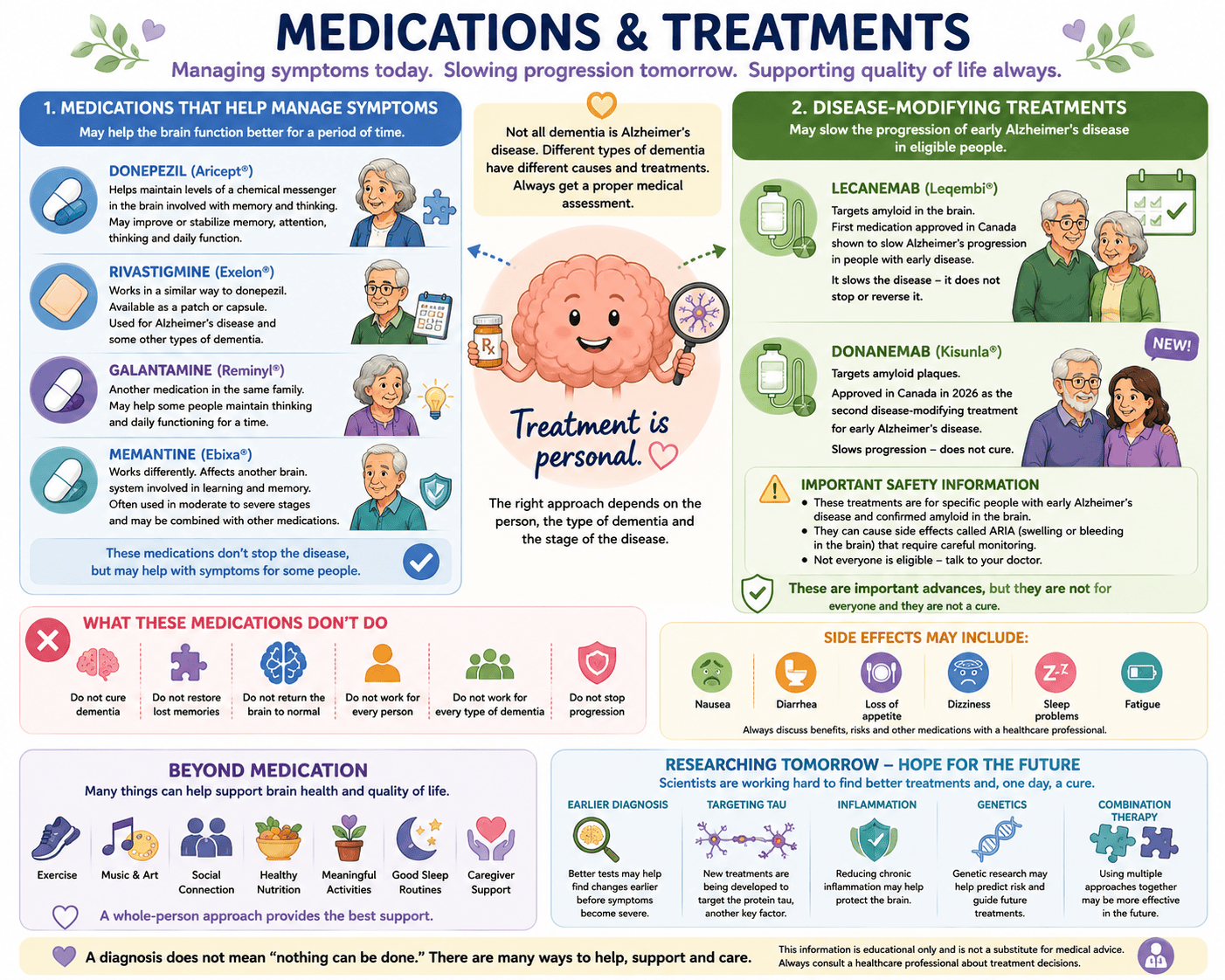

Donepezil — Aricept®
Donepezil is one of the commonly used Alzheimer’s medications.
It belongs to a group called cholinesterase inhibitors.
In very simple terms, it helps maintain levels of a chemical messenger in the brain involved with memory and thinking.
Some people may experience improvements or stabilization in:
Memory • Attention • Thinking • Communication • Everyday functioning
It isn’t a cure, and Alzheimer’s can continue to progress while someone is taking it.

Rivastigmine — Exelon®
Rivastigmine works in a similar way.
One useful difference is that it can be available as a skin patch, which may be easier for some people than taking another pill every day.
It is used for Alzheimer’s disease and in some circumstances dementia associated with Parkinson’s disease.

Galantamine — Reminyl®
Galantamine is another cholinesterase inhibitor.
Like donepezil and rivastigmine, it may help some people maintain cognitive and everyday abilities for a period of time.
Again:
It manages symptoms. It does not cure Alzheimer’s disease.
The Alzheimer Society notes that Health Canada has approved several medications for Alzheimer’s symptom management.

Memantine — Ebixa®
Memantine works differently.
It affects another brain communication system involving glutamate.
It is generally used later in Alzheimer’s disease than the cholinesterase inhibitors and may sometimes be combined with one of them.
Its goal is still symptom management rather than curing the underlying disease

Side Effects Matter
Like any medication, dementia medications can cause side effects.
Depending on the medication, these may include things such as:
Nausea • Diarrhea • Loss of appetite • Dizziness • Headache • Sleep problems • Fatigue
Other effects are possible, and some people shouldn’t take particular medications because of other medical conditions or medications they already use.
That’s why these drugs should be prescribed and monitored by a healthcare professional

What These Medications DON'T Do
They do NOT:
❌ Cure dementia
❌ Restore memories that have permanently been lost
❌ Return the brain to its previous condition
❌ Work for every person
❌ Work for every type of dementia
❌ Guarantee that symptoms won’t worsen
But that doesn’t mean treatment isn’t worthwhile. For some people, maintaining independence or cognitive abilities for longer can be very meaningful.

A New Generation of Alzheimer's Treatments
This is where the story becomes particularly interesting.
Canada has entered a new era of Alzheimer’s treatment.
Rather than only treating symptoms, newer medications target amyloid, one of the abnormal proteins associated with Alzheimer’s disease.
Lecanemab Leqembi®
Lecanemab became the first medication approved in Canada shown to slow Alzheimer’s progression while targeting the underlying biology of the disease.
It is intended for certain adults with mild cognitive impairment or mild dementia due to Alzheimer’s disease, with confirmed amyloid pathology and specific genetic eligibility requirements.
What does that mean in plain English?
Instead of simply helping brain cells communicate better, lecanemab targets amyloid buildup in the brain.
Clinical studies showed that it can slow decline in memory, thinking and everyday functioning.
But:
It slows Alzheimer’s. It does not stop or reverse it.
That distinction is extremely important.

Donanemab — Kisunla®
On May 1, 2026, Health Canada approved donanemab (Kisunla), making it Canada’s second approved disease-modifying Alzheimer’s treatment.
It is intended for eligible adults with:
Mild cognitive impairment due to Alzheimer’s or
Mild dementia due to Alzheimer’s disease
with confirmed amyloid pathology and specified ApoE genetic status.
Donanemab also targets amyloid plaques.
⚠️ These New Treatments Aren’t For Everyone
This needs to be very clear on the website.
Someone can’t simply be diagnosed with “dementia” and receive one of these drugs.
Eligibility involves confirming that the person’s symptoms are caused by Alzheimer’s disease, confirming amyloid pathology and assessing other medical and genetic factors.
These medications can also cause an important side effect known as:
ARIA Amyloid-Related Imaging Abnormalities
This can involve swelling or bleeding in the brain.
For that reason, patients receiving these treatments require careful medical assessment and monitoring.
So while these medications represent genuine progress, they’re not simple miracle drugs.
Treating More Than Memory
Dementia care isn’t only about memory medication. People living with dementia can also experience:
Depression • Anxiety • Sleep difficulties • Agitation • Hallucinations • Pain • Behaviour changes
Healthcare professionals may sometimes recommend medications for particular symptoms.
However, medication isn’t automatically the first or only answer.
For example, if someone suddenly becomes agitated, the first questions should sometimes be:
Are they in pain? Are they constipated? Are they frightened? Do they have an infection? Are they hungry or thirsty?
Has something changed in their environment? A sudden change in behaviour indicate an underlying medical problem and deserves medical attention.
Treatment Doesn’t Always Mean Medication
Treatment and care can include:
Exercise, Music, Social interaction, Meaningful Activities, Good nutrition, Sleep routines, Occupational therapy, Physical therapy
Communication strategies, A safe environment, Caregiver education
Medication is one part of dementia care, not the entire answer.
New Research & Future Directions
Scientists are investigating several approaches.
Earlier Diagnosis
Researchers are developing better ways to detect Alzheimer’s changes before significant symptoms develop, including improved biomarkers and blood-based testing.
Earlier identification could become increasingly important because disease-modifying treatments are designed for people in the earliest stages.
Targeting Tau
Amyloid isn’t the only abnormal protein associated with Alzheimer’s.
Researchers are also studying tau, another protein strongly associated with damage inside brain cells.
Inflammation
Scientists are investigating the role that chronic inflammation and the brain’s immune system may play in Alzheimer’s disease.
Genetics
Research into genetics may help identify why some people develop Alzheimer’s while others don’t and could eventually help physicians select treatments more precisely.
Combination Treatment
One particularly interesting direction is combining therapies that attack Alzheimer’s through several biological pathways rather than just one.
The long-term idea could eventually resemble treatment of other complex diseases:
Target amyloid + target tau + control inflammation + protect brain cells.
Research is increasingly exploring these multi-target approaches, although much of this remains investigational rather than established treatment.
What Families Should Remember
MEDICATION CAN HELP
Some medications can improve or stabilize symptoms.
NEW TREATMENTS CAN SLOW ALZHEIMER’S
Certain newer medications can slow progression in eligible people with early Alzheimer’s.
THERE IS CURRENTLY NO CURE
No approved treatment currently reverses Alzheimer’s or other progressive dementias.
RESEARCH IS MOVING FORWARD
New approaches involving amyloid, tau, inflammation, biomarkers and combination therapies continue to be studied.
A Diagnosis Does Not Mean “Nothing Can Be Done”
There may be medications, lifestyle changes, therapies, activities, safety measures and support services that can improve someone’s comfort, independence and quality of life.
Treatment should be individualized because the right approach for one person may not be right for another.
Important: This information is educational and isn’t a substitute for medical advice. Dementia medications can have significant benefits, risks and interactions. Medication should never be started, stopped or changed without discussing it with a physician, pharmacist or other qualified healthcare professional.
- Alzheimer Society of Canada — Dementia Treatment Options & Developments
Dementia Treatment Options & Developments
Probably the best overall link for this page. It explains medications used for dementia, treatments currently available in Canada, alternative treatments, medication risks, and newer developments such as disease-modifying treatments. - Government of Canada — Dementia: Symptoms and Treatment
Government of Canada — Dementia Treatment Information
This is a great authoritative resource. It covers both drug and non-drug treatments and discusses medications such as donepezil, rivastigmine, galantamine and memantine. - Alzheimer Society of BC & Yukon — Treatment Information
Alzheimer Society of BC & Yukon
This is especially appropriate for Your Next Step since you’re starting the site in British Columbia. It provides information about approved Alzheimer’s medications, alternative approaches and potential future treatments.