
Daily Support & Care

Daily Support & Care
Caring for someone living with dementia can sometimes be challenging, but small changes in the way we communicate, organize the home, and offer help can make an enormous difference.
The goal isn’t to do everything for the person. Whenever possible, the goal is to help them continue doing the things they can safely do, while providing support where it is needed.
💬 How to Communicate
As dementia progresses, a person may have more difficulty finding words, following a conversation, remembering what was just said, or understanding complicated instructions. They may ask the same question repeatedly or tell the same story several times.
One of the most important things to remember is that the person’s difficulty communicating is part of the condition. Correcting them repeatedly or pointing out that they have already asked a question can lead to frustration, embarrassment, or anxiety.
Give simple choices
Too many choices can become overwhelming.
Instead of: “What would you like to wear today?”
Try: “Would you like the blue shirt or the green shirt?”
The same approach can work with meals, activities and everyday decisions.
Don’t turn everything into a correction
If someone says something that isn’t accurate but isn’t causing harm, correcting every detail may not accomplish anything useful.
For example, if someone believes an event happened yesterday when it actually happened several years ago, arguing over the date may simply create frustration.
Sometimes it is more helpful to respond to the feeling behind what they’re saying and gently redirect the conversation.
Keep communication simple
Speak clearly and naturally. Use shorter sentences and try to discuss one thing at a time.
Instead of saying: “Get dressed, brush your teeth, grab your jacket and shoes because we’re leaving in 20 minutes.”
Try: “Let’s get dressed.”
Then move to the next step when they’re ready.
Give the person enough time to respond. Sometimes they understand perfectly well but simply need longer to process the question and find the words they want.
Communication isn’t only about words. Facial expressions, gestures, tone of voice and body language can become increasingly important.
A warm expression and calm voice can sometimes communicate more effectively than a long explanation.
Remember the person is still there
Talk to the person, not about them while they’re sitting in the room.
Include them in conversations and decisions whenever possible.
Dementia may affect someone’s memory and communication abilities, but they can still experience happiness, humour, affection, embarrassment, frustration, pride and love.
Try to focus on what the person can still do, rather than constantly pointing out what has become difficult. Encourage independence wherever it is safe and practical. Something as simple as allowing someone to choose their clothes, help prepare a meal, fold laundry or decide what music to listen to can help preserve confidence and a sense of purpose.
It can also be tempting to correct every mistake or remind someone that they’ve already asked the same question. Often, being kind is more important than being right. If correcting someone will only cause embarrassment, frustration or distress, sometimes reassurance and gently redirecting the conversation is the better choice.
Creating a Safe Environment
A familiar home can provide comfort and independence, but dementia can gradually change how someone understands their surroundings.
Something that was perfectly safe for years may eventually become confusing or hazardous.
The idea isn't necessarily to transform someone's home overnight. Instead, make sensible changes as their needs change.
Reduce falls and obstacles
Think about wandering
Make the kitchen safer
Medication safety
Bathroom safety
Look around the home differently

Supporting Independence
One of the biggest mistakes families can unintentionally make is taking over too quickly.
When somebody begins having difficulty with certain tasks, it’s natural to want to help. But doing everything for someone can sometimes remove abilities and routines they are still capable of maintaining.
Whenever it is safe, encourage the person to continue participating in everyday life.
Let them do what they can
Someone may still be able to:
- Fold towels or laundry
- Set the table
- Water plants
- Make a simple snack
- Brush their hair
- Choose their clothes
- Walk the dog with appropriate support
- Help prepare food
- Work in the garden
- Listen to favourite music
- Participate in familiar hobbies
It doesn’t necessarily matter if the towels aren’t folded perfectly or the table isn’t set exactly right.
Participation can be more important than perfection.
Break activities into smaller steps
A complicated activity can become manageable when it’s divided into individual steps.
Rather than taking over completely, provide the smallest amount of assistance necessary.
For example:
“Here is your toothbrush.” Then allow the person to continue.
If they need another cue:
“Let’s put some toothpaste on it.”
This allows them to remain involved rather than becoming a spectator in their own daily life.
Maintain familiar routines
Routine can provide tremendous comfort.
Getting up around the same time, having meals at familiar times, taking a regular walk and maintaining established bedtime routines can make the day more predictable.

Focus What Someone CAN Do
Dementia can understandably cause families to concentrate on everything a person is losing.
But there is another way of looking at it.
Instead of continually asking:
“What can they no longer do?”
Ask:
“What can they still do—and how can we help them keep doing it?”
Someone may forget what happened yesterday but remember every word of an old song.
They may struggle with money but still love gardening.
They may have difficulty carrying on a complicated conversation but still laugh at a joke.
They may forget names while still recognizing that someone makes them feel safe and loved.
Those abilities matter.
Whenever possible, try to adapt an activity rather than take it away completely. Someone who can no longer prepare an entire meal might still wash vegetables, stir ingredients or set the table. Someone who once loved gardening may still enjoy watering plants, pulling a few weeds or simply sitting outside surrounded by flowers.
Familiar activities can also provide comfort. Music, photographs, favourite foods, pets, hobbies, family traditions and familiar places may create moments of connection even when memories have become difficult to access. The activity doesn’t need to be completed perfectly for it to be worthwhile.
Try not to measure every good moment by whether the person will remember it tomorrow. An experience can still have value while it is happening. A walk in the sunshine, a favourite song, holding someone’s hand or laughing together can bring genuine happiness even if the details of that moment are later forgotten.
As abilities change, expectations may need to change too. The goal isn’t to test someone’s memory or continually remind them of what they can no longer do. It’s to create opportunities for success, connection and enjoyment.
Most importantly, look for the person beyond the dementia. Their abilities may change, but their need to feel useful, included, respected and loved remains.
Sometimes the question isn’t “What has dementia taken away?” but “What can we help preserve?”
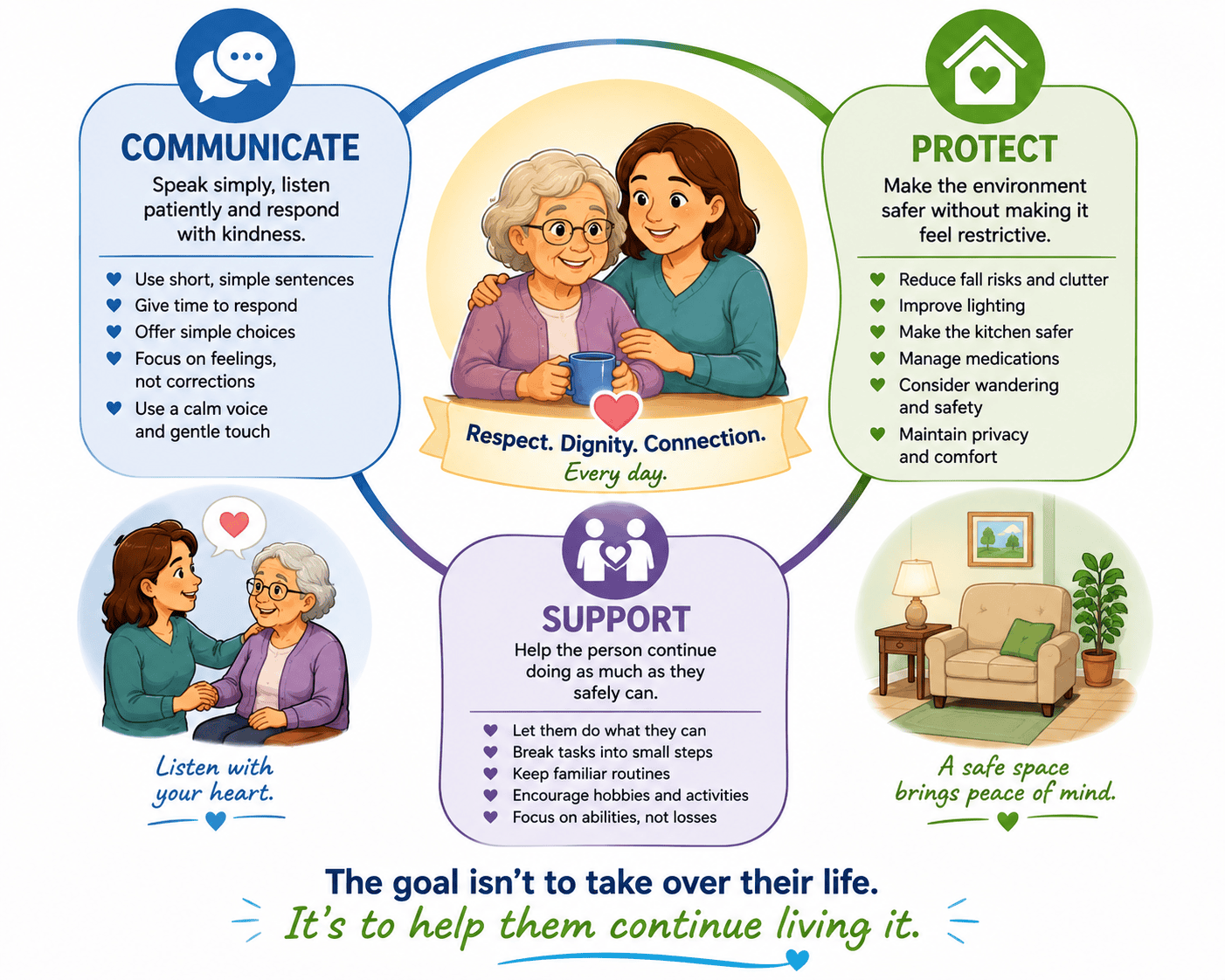
A Simple Approach to Remember
COMMUNICATE → PROTECT → SUPPORT
COMMUNICATE: Speak simply, listen patiently and respond with kindness.
PROTECT:Make the environment safer without making it feel restrictive.
SUPPORT:Help the person continue doing as much as they safely can.
The goal isn’t to take over their life. It’s to help them continue living it.
🇨🇦 Trusted Resources — Learn More
- Government of Canada — How to Communicate With a Person Living With Dementia
A very practical guide covering simple language, patience, eye contact, reducing distractions, body language and ways to communicate when someone is having difficulty understanding.
Communication Tips – Government of Canada - Alzheimer Society of Canada — Making Your Environment Safe
This fits perfectly with our PROTECT section. It explains how to make a home more dementia-friendly while balancing safety with independence, rather than unnecessarily restricting the person.
Making Your Environment Safe – Alzheimer Society of Canada - Alzheimer Society of Canada — Providing Day-to-Day Care
This is a good companion to our SUPPORT section. It includes information about respecting independence and decision-making, staying mobile and safe, and finding suitable everyday activities.
Providing Day-to-Day Care – Alzheimer Society of Canada