
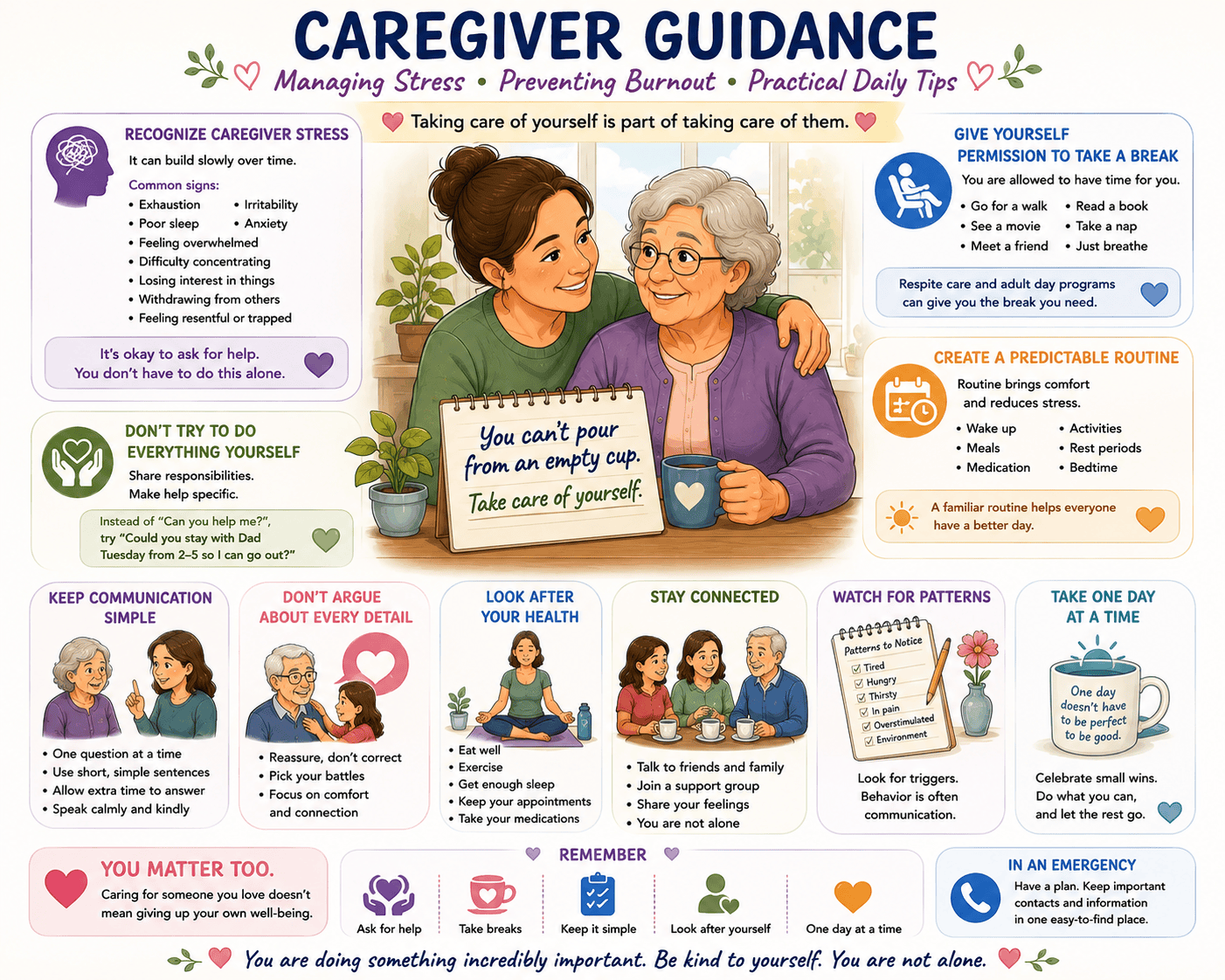
Caregiver Guidance

Managing Stress
Preventing Burnout • Practical Daily Tips
Caring for someone living with dementia can be incredibly meaningful, but it can also be physically and emotionally exhausting.
A caregiver may be helping with meals, medications, appointments, bathing, dressing, finances, transportation and household responsibilities while also dealing with memory loss, repeated questions, confusion, changes in behaviour and disrupted sleep.
And somewhere in the middle of all that, the caregiver still has their own life, health, family and responsibilities to look after.
One of the most important things to remember is:
Taking care of yourself is part of taking care of them.
Understanding Caregiver Stress
Caregiver stress doesn’t necessarily arrive all at once.
It can build gradually.
At first you may simply feel more tired than usual. Then you might notice you’re becoming frustrated more easily, sleeping poorly, cancelling plans or feeling like you’re constantly “on duty.”
Some common warning signs can include:
Exhaustion • Irritability • Poor sleep • Anxiety • Feeling overwhelmed • Difficulty concentrating • Losing interest in things you enjoy • Withdrawing from friends or family • Feeling resentful or trapped
Everyone has difficult days.
But when those difficult days become most days, it’s time to pay attention.

What Is Caregiver Burnout?
Burnout is more than simply being tired.
It can happen when the physical and emotional demands of caregiving continue for a long time without enough rest, assistance or support.
A caregiver may begin to feel that they simply have nothing left to give.
This is exactly why families shouldn’t wait until someone reaches their breaking point before asking for help.
Caregiver burnout can build slowly and quietly. At first, someone may simply feel more tired than usual or find themselves becoming impatient over small things. Over time, they may begin losing interest in activities they once enjoyed, withdrawing from friends and family, having difficulty sleeping or feeling constantly worried, frustrated or overwhelmed.
Some caregivers also experience guilt about needing a break. They may feel that because they love the person, they should be able to handle everything themselves. But caregiving can be demanding work, particularly as dementia progresses and the person begins needing more supervision and assistance with everyday activities.
Getting help early is much easier than recovering from complete exhaustion.

Don't Try to Do Everything Yourself
This may be one of the most important messages on the entire page.
Many caregivers naturally say:
“I’m okay.”
“I can handle it.”
“Nobody else knows how to do it properly.”
And before long, one person is doing almost everything.
Instead, divide responsibilities whenever possible.
One family member might handle medical appointments. Another might take care of groceries. Someone else could visit every Saturday afternoon. Another could help with finances or transportation.
Make help specific.
Instead of saying:
“Can somebody help me?”
try: “Could you stay with Mom Wednesday from 2–5 so I can go out?”
Specific requests are much easier for people to respond to.

Create a Predictable Daily Routine
People living with dementia often do better when life feels familiar and predictable.
Try keeping things such as:
Wake-up time • Meals • Medication • Activities • Rest periods • Bathing • Bedtime
at roughly similar times each day.
You don’t need a military schedule.
The goal is simply to reduce unnecessary surprises and decisions.
A familiar routine can make the day easier for both the person with dementia and the caregiver.
Make the Environment Work for You
Small changes around the home can reduce stress for everyone.
Consider:
Clear walkways • Good lighting • Labels on drawers • Large clocks and calendars • Frequently used objects kept in familiar places • Reduced clutter • Simple signs • Night-lights • Removing obvious trip hazards
The easier the environment is to understand, the fewer problems the caregiver may have to solve.

Keep Communication Simple
When someone’s ability to process information changes, long explanations can become confusing.
Try:
One question at a time.
Instead of:
“Do you want to shower now, get dressed and then we’ll have breakfast before we go to the doctor?”
Try: “Would you like to get dressed?”
Then move on to the next step.
Speak calmly, allow extra time for an answer and avoid rushing whenever possible.
Pick Your Battles
Not everything needs to happen perfectly.
If someone wants to wear the same favourite sweater again and it’s clean enough maybe that’s okay.
If dinner ends up being scrambled eggs instead of the meal you planned also okay.
If an activity isn’t working today try something else.
Safe, comfortable and content often matter more than perfect.

Give Yourself Permission to Take a Break
You are allowed to have time away from caregiving.
That could mean:
Going for a walk • Having lunch with a friend • Seeing a movie • Exercising • Gardening • Taking a nap • Spending time with your spouse or children • Simply sitting somewhere quietly
You don’t need to spend every available minute being productive.
Sometimes you just need to switch off for a while.
Respite care, adult day programs and assistance from friends or family can help create these breaks.

Protect Your Sleep
Sleep deprivation makes almost everything harder.
It can affect patience, concentration, mood and physical health.
If the person you’re caring for is frequently awake during the night, wandering or requiring assistance, talk with their healthcare team.
There may be ways to improve nighttime routines or address medical, environmental or behavioural factors contributing to the problem.
And when another trusted person can safely take over for a while:
Sleep.
The laundry can wait.

Don't Argue About Every Detail
This one can save caregivers an enormous amount of frustration.
If someone with dementia says something that isn’t accurate, correcting them isn’t always necessary.
If Dad insists it’s Tuesday when it’s Wednesday, ask yourself:
Does correcting this actually matter?
Safety matters.
Medication matters.
But winning an argument about what day it is often doesn’t.
Sometimes reassurance and redirection work much better than confrontation.

Repeated Questions Aren't Intentional
A person might ask: “What time are we leaving?”
You answer.
Three minutes later: “What time are we leaving?”
Then again. And again.
They may genuinely have no memory of asking the question before.
A whiteboard, clock, calendar or written note may sometimes help:
“Doctor 2:00 PM. We leave at 1:30.”
That gives the person somewhere to look for the answer instead of depending entirely on the caregiver.

Watch for Patterns
If difficult behaviour regularly occurs at a particular time, look for a reason.
Ask:
Are they tired?
Hungry?
Thirsty? In pain? Overstimulated? Lonely?
Constipated? Too hot or cold? Confused by their surroundings?
Behaviour can sometimes be a person’s way of communicating a need they can no longer easily explain.
A simple notebook can help caregivers notice patterns.

Encourage Independence
It’s tempting to start doing everything for someone because it’s faster.
But if the person can still safely do something themselves, allow them to try.
Maybe they can still:
Fold towels • Make toast • Water plants • Choose clothing • Set the table • Brush their hair • Feed a pet
It may take longer. That’s okay.
Maintaining abilities can support confidence, dignity and independence.

Look After Your Own Health
Caregivers need healthcare too.
Don’t continually postpone your own:
Doctor appointments • Dental care • Exercise • Healthy meals • Sleep • Prescriptions • Social life
You can’t indefinitely run yourself on empty.
And if you’re struggling emotionally, tell someone.
Your doctor, counsellor, family, caregiver support group or dementia-support organization can be a starting point.
Have a Backup Plan
Every caregiver should eventually answer one important question:
What happens if I suddenly can’t provide care tomorrow?
Keep important information somewhere accessible:
Emergency contacts • Medication list • Doctors • Medical information • Daily routine • Pharmacy • Important documents • People who can step in
Ideally, at least one other trusted person should understand the basic care routine.
Don’t wait for an emergency to create the emergency plan.
Five Things Every Caregiver Should Remember
ASK FOR HELP — You don’t have to do everything yourself.
TAKE BREAKS — Rest isn’t selfish; it’s necessary.
KEEP THINGS SIMPLE — Routine and simplicity can make everyone’s day easier.
LOOK AFTER YOURSELF — Your health matters too.
ONE DAY AT A TIME — You don’t have to solve every future problem today.

Find People Who Understand
Sometimes you need more than advice.
You need someone who understands what it’s actually like.
Caregiver support groups allow people to share experiences and hear practical ideas from others dealing with similar situations.
Sometimes hearing:
“Yes, we’ve been through that too.”
can be enormously reassuring.
Remember the Relationship
This one is easy to lose.
Before you became someone’s caregiver, you were their:
Husband. Wife. Daughter. Son. Sister. Brother. Friend.
Try to preserve moments where you’re simply together.
Listen to music.
Look through photographs.
Have coffee.
Watch an old movie.
Sit outside.
Laugh when something funny happens.
Not every interaction needs to involve medication, appointments, bathing, schedules or dementia.
There is still a relationship underneath the caregiving.
YOU MATTER TOO
Caring for someone you love doesn’t mean giving up your own health and well-being. Accept help, take breaks, stay connected and remember that looking after the caregiver is an important part of looking after the person living with dementia.
Family Caregivers of British Columbia — Get Help — An excellent resource. It provides caregiver support, healthcare-system navigation, emotional support, support groups and educational resources. They also operate a BC Caregiver Support Line for people who need someone knowledgeable to talk to.
Alzheimer Society of Canada — Finding Help for Caregivers — It explains support groups, one-on-one help, respite care, adult day programs and getting assistance with everyday caregiving tasks such as meals, transportation and household responsibilities